
Reducing Barriers to Collaboration Through Practical Tools and Technology
Behavior analysts rarely work in isolation as the individuals receiving ABA therapy are likely supported by many other providers. Although these providers may work in different settings or organizations, their decisions affect the same person. At its best, interdisciplinary collaboration is not simply the exchange of reports; it is a process of combining areas of expertise while keeping the client’s needs, preferences, assent, culture, and quality of life at the center. The goal is coordinated care: clear roles, compatible priorities, and fewer instances of the client or family managing competing recommendations on their own.1,2
Behavior can be influenced by variables that may not be observable during an ABA session, including pain, sleep, medication effects, trauma, and cognitive limitations. Because individuals with intellectual and developmental disabilities often have needs spanning several domains, no single provider may have all the information required for a comprehensive assessment.1,6 This is where collaboration comes in; coordinated care brings these perspectives together. Despite the obvious value of coordinated care, achieving it consistently can be difficult within the realities of everyday practice.
Practical Strategies for Collaboration
Most barriers to collaboration are not caused by a lack of concern; rather, they reflect systems that do not provide the support, infrastructure, or financial resources necessary for meaningful coordination. Limited time, incompatible schedules, billing restrictions, separate record systems, unclear roles, staff turnover, and incomplete releases can impede communication and leave families responsible for carrying information between providers.3 Although individual clinicians cannot eliminate these systemic barriers, they can reduce their day-to-day impact. Standardized templates, automated scheduling, shared workflows, and organization-approved, HIPAA-compliant AI tools can reduce administrative burden and make communication more efficient. The following small, repeatable strategies can help behavior analysts incorporate meaningful collaboration into busy clinical practice: 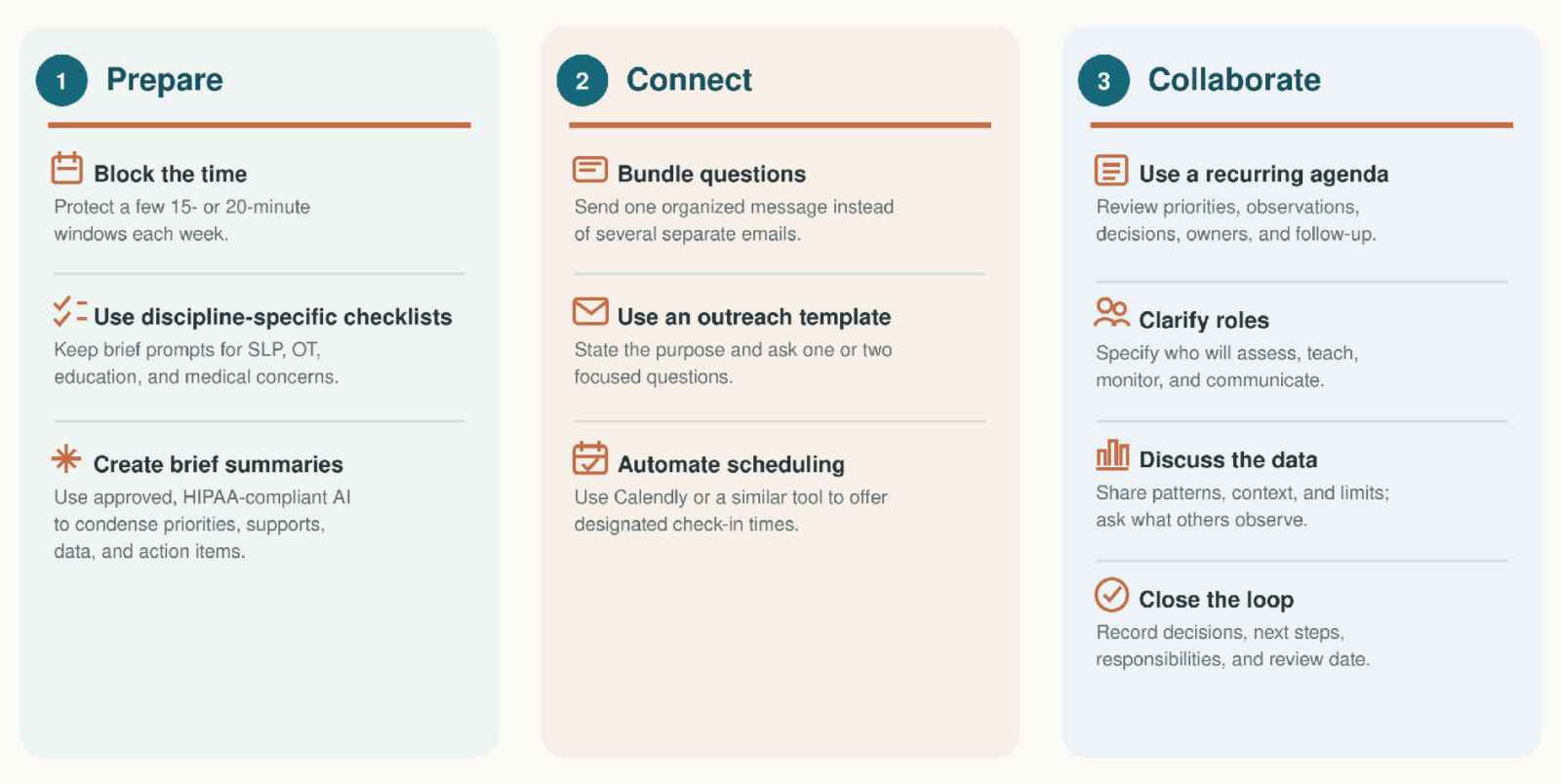
Prepare
-
At intake and major transitions, identify the providers most relevant to the referral question and obtain consent for communication.
-
Describe the client’s priorities, current supports, relevant data, and the specific question in plain, discipline-neutral language. Organization-approved, HIPAA-compliant AI tools can help condense notes into a one-page summary (verify before sharing).
-
Maintain brief prompts for common areas of collaboration, such as communication access, sensory or motor demands, educational expectations, medication changes, sleep, and emotional functioning.
Connect
-
Keep a running list for each provider and send one organized message rather than multiple emails. Specific questions (e.g., “Have you noticed changes since the medication adjustment?”) are easier to answer than broad requests to collaborate and produce more useful information.
-
Use a brief email template that summarizes the purpose of the communication, provides essential context, and clearly identifies what input is needed.
-
Protect several 15- or 20-minute collaboration blocks each week and use scheduling tools such as Calendly to reduce back-and-forth. Short calls, secure updates, and strategically selected meetings can support collaboration without requiring frequent full-team meetings.3,6
Collaborate
-
Structure meetings around the current priority, observations across settings, relevant data and limitations, decisions needed, assigned responsibilities, and the follow-up date.
-
When goals overlap, specify who will assess, teach, monitor, and communicate each component. Clear roles reduce duplication, mixed messages, and scope concerns.1,4
-
Share patterns, context, and limitations of the data. Ask whether other team members observe the same pattern.
For Supervisors
-
Include consultation, interdisciplinary communication, and respectful disagreement in supervision. This is particularly important because many behavior analysts collaborate frequently but receive little formal training in doing so.7
References
-
Bowman, K. S., Suarez, V. D., & Weiss, M. J. (2021). Standards for interprofessional collaboration in the treatment of individuals with autism. Behavior Analysis in Practice, 14(4), 1191–1208. https://doi.org/10.1007/s40617-021-00560-0
-
LaFrance, D. L., Weiss, M. J., Kazemi, E., Gerenser, J., & Dobres, J. (2019). Multidisciplinary teaming: Enhancing collaboration through increased understanding. Behavior Analysis in Practice, 12(3), 709–726. https://doi.org/10.1007/s40617-019-00331-y
-
Wei, H., Horns, P., Sears, S. F., Huang, K., Smith, C. M., & Wei, T. L. (2022). A systematic meta-review of systematic reviews about interprofessional collaboration: Facilitators, barriers, and outcomes. Journal of Interprofessional Care, 36(5), 735–749. https://doi.org/10.1080/13561820.2021.1973975
-
Gasiewski, K., Weiss, M. J., Leaf, J. B., & Labowitz, J. (2021). Collaboration between behavior analysts and occupational therapists in autism service provision: Bridging the gap. Behavior Analysis in Practice, 14(4), 1209–1222. https://doi.org/10.1007/s40617-021-00619-y
-
McNeil, K., Gemmill, M., Abells, D., Sacks, S., Broda, T., Morris, C. R., & Forster-Gibson, C. (2018). Circles of care for people with intellectual and developmental disabilities: Communication, collaboration, and coordination. Canadian Family Physician, 64(Suppl 2), S51–S56.
-
Kelly, A., & Tincani, M. (2013). Collaborative training and practice among applied behavior analysts who support individuals with autism spectrum disorder. Education and Training in Autism and Developmental Disabilities, 48(1), 120–131. https://doi.org/10.1177/215416471304800111